









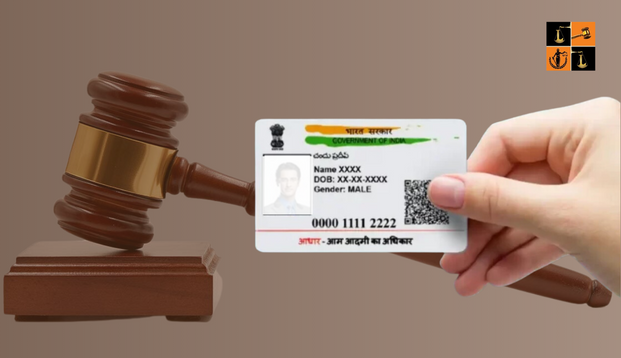
Recently, the Bombay High Court held that genuine citizens cannot be forced to suffer indefinitely because of biometric or technical irregularities in the Aadhaar system, while directing the Unique Identification Authority of India to adopt a more transparent and citizen-friendly mechanism for rectification of Aadhaar records. The Division Bench of Justice Ravindra V. Ghuge and Justice Hiten S. Venegavkar observed that “a genuine resident cannot be left remediless merely because a technological or biometric anomaly has occurred in the system,” while cautioning authorities against pushing citizens into endless administrative uncertainty.
Brief facts:
The case arose from a writ petition filed under Article 226 of the Constitution by two young applicants seeking directions to the Unique Identification Authority of India to either update their biometric details or permit fresh Aadhaar enrollment under the provisions of the Aadhaar Act, 2016 and the Aadhaar (Enrollment and Update) Regulations, 2016. The dispute stemmed from repeated rejection of their biometric updation requests on the grounds of a mismatch in Aadhaar records created during their minority.
Despite multiple approaches to the authorities, the petitioners were subjected to shifting administrative responses, including advice to seek cancellation, fresh enrollment and biometric correction, before eventually being informed that their Aadhaar numbers stood suspended or cancelled. The prolonged uncertainty adversely affected their access to educational admissions, identity verification and other essential services, ultimately compelling them to approach the High Court seeking a lawful and time-bound remedy.
Contentions of the Petitioner:
The Petitioners argued that the twins had committed no fraud, impersonation or suppression and that any biometric mismatch could only have arisen because the enrollment process was undertaken when they were children. It was submitted that the petitioners had diligently complied with every instruction issued by UIDAI authorities, yet were continuously shifted from one administrative process to another without any final resolution. Stressing that Aadhaar had become an indispensable identity document for education, insurance and civic access, the petitioners contended that the statutory authority was under an obligation to either rectify the records or permit fresh enrollment within a reasonable timeframe. Reliance was also placed on the constitutional requirement of fairness and reasonableness in administrative action.
Contentions of the Respondent:
On the other hand, Counsel appearing for UIDAI defended the action by contending that the petitioner’s records reflected biometric anomalies detected during technical verification. The Respondent argued that the integrity of the Central Identities Data Repository was a matter of national importance and biometric safeguards could not be mechanically bypassed. UIDAI maintained that while the petitioners were free to apply for fresh enrollment with updated biometrics and supporting documents, the authority was required to act strictly within the framework of the Aadhaar Act, 2016 and the Aadhaar (Enrollment and Update) Regulations, 2016, to prevent duplication, impersonation or fraudulent enrollment.
Observation of the Court:
The Division Bench of Justice Ravindra V. Ghuge and Justice Hiten S. Venegavkar observed that “the Aadhaar framework established under the Aadhaar (Targeted Delivery of Financial and Other Subsidies, Benefits and Services) Act, 2016 constitutes one of the foundational identity infrastructures of the country. The object of the enactment is not merely to create a technological database, but to establish a reliable and accessible identity mechanism for residents so as to facilitate delivery of welfare measures, public services, institutional access and effective governance. The State, therefore, has a legitimate administrative and constitutional interest in ensuring that every eligible resident possesses a valid and functional Aadhaar identity. At the same time, implementation of the statutory framework must remain citizen-centric, facilitative and constitutionally compliant.”
The Court observed that the statutory framework governing Aadhaar does not permit authorities to keep citizens trapped in an endless cycle of administrative uncertainty merely because a biometric mismatch has surfaced in the system. Referring to the Aadhaar Act, 2016 and the Aadhaar (Enrollment and Update) Regulations, 2016, the Bench clarified that the law itself recognises situations involving deactivation, omission, fresh enrollment and biometric correction. The Court emphasised that if an Aadhaar number stands deactivated, the authority is duty-bound to indicate a lawful rectification pathway, and if fresh enrollment becomes necessary, the process must be facilitated in a transparent and time-bound manner. The Bench made it clear that genuine residents cannot be left without any effective remedy merely because technological discrepancies have arisen during the enrollment or updation process.
The Bench held that the conduct of the authorities in repeatedly shifting the petitioners from one administrative process to another was deeply unsatisfactory, especially considering that the petitioners were young students dependent on Aadhaar for educational admissions and allied purposes. The Court noted that the petitioners were first asked to update their biometrics, then advised to seek cancellation, later informed that cancellation procedures had been withdrawn, and eventually told that their Aadhaar numbers had been suspended or cancelled. According to the Court, such inconsistent communication from a statutory authority dealing with foundational identity credentials creates avoidable hardship and undermines procedural fairness. The Bench stressed that authorities administering essential identity systems are expected to provide clear, written and legally sustainable guidance rather than forcing citizens into repeated and futile visits to government offices.
The Court emphasised that while the integrity and purity of the Aadhaar database are matters of national importance, the implementation of the Aadhaar framework must remain humane, citizen-centric and constitutionally compliant. Relying upon the Constitution Bench ruling in Justice K.S. Puttaswamy (Retd.)and Anr. vs. Union of India and Ors., the Bench reiterated that constitutional safeguards against exclusion form an integral part of the Aadhaar architecture. The Court clarified that biometric safeguards and verification mechanisms cannot become tools for denying legitimate residents access to identity credentials, particularly when there is no allegation of fraud, impersonation or duplication. The Bench further highlighted that the State’s legitimate interest in maintaining database security must be balanced with the constitutional obligation to ensure fairness, accessibility and dignity for ordinary citizens.
The Bench further observed that constitutional courts are increasingly witnessing cases where citizens are compelled to approach the judiciary because of technical irregularities such as biometric mismatch, failed updation, suspension or cancellation of Aadhaar records. The Court noted with concern that students, senior citizens, labourers and economically weaker persons are often made to repeatedly visit different offices without receiving effective guidance or final resolution. According to the Bench, such situations not only create unnecessary hardship but also result in denial of access to essential services and lead to avoidable litigation.
The decision of the Court:
In light of the foregoing discussion, the Court directed the Petitioners, while disposing of the writ petition, to submit fresh Aadhaar enrollment applications with updated biometrics within fifteen days and ordered UIDAI to process the applications strictly in accordance with law within four weeks. The Court further directed that the applications shall not be rejected merely because the earlier Aadhaar numbers had been suspended, omitted or cancelled on account of biometric mismatch, unless any independent case of fraud or impersonation is detected.
Case Title: Rohit Bandu Nikalje, and Anr. Vs. The Regional Officer, UIDAI, Ors.
Case No.: Writ Petition No. 10771 of 2025
Coram: Hon’ble Mr. Justice Hiten S. Venegavkar, Hon’ble Mr. Justice Ravindra V. Ghuge
Advocate for the Petitioner: Adv. Harshada Shirsath, Adv. Ramaprasad Deore, Adv. Swaraj Sabale
Advocate for the Respondent: AGP P. N. Diwan, Adv. P. P. Kakade, Adv. Shehnaz V. Bharucha, Adv. Gargi Warunjikar,
Read Judgment @Latestlaws.com
Picture Source :




















